| Nondestructive testing asks "Is there something wrong with this material?" Various performance and proof tests, in contrast, ask "Does this component work?" This is the reason that it is not considered nondestructive testing when an inspector checks a circuit by running electric current through it. Hydrostatic pressure testing is usually proof testing and intrinsically not nondestructive testing. Acoustic emission testing used to monitor changes in a pressure vessel's integrity during hydrostatic testing is nondestructive testing.
|
|
Another gray area that invites various interpretations in defining nondestructive testing is that of future usefulness. Some material investigations involve taking a sample of the inspected part for testing that is inherently destructive. A noncritical part of a pressure vessel may be scraped or shaved to get a sample for electron microscopy, for example. Although future usefulness of the vessel is not impaired by the loss of material, the procedure is inherently destructive and the shaving itself - in one sense the true "test object" - has been removed from service permanently.
|
|
The idea of future usefulness is relevant to the quality control practice of sampling. Sampling (that is, the use of less than 100 percent inspection to draw inferences about the unsampled lots) is nondestructive testing if the tested sample is returned to service. If the steel is tested to verify the alloy in some bolts that can then be returned to service, then the test is nondestructive. In contrast, even if spectroscopy used in the chemical testing of many fluids is inherently nondestructive, the process is destructive if the test samples are discarded after testing.
|
|
Hardness testing by indentation provides an interesting test case for the definition of nondestructive testing. Hardness testing machines look somewhat like drill presses. The applied force is controlled as the bit is lowered to make a small dent in the surface of the test piece. Then the diameter or depth of the dent is measured. The force applied is correlated with the dent size to provide a measurement of surface hardness. The future usefulness of the test piece is not impaired, except in rare cases when a high degree of surface quality is important. However, because the piece's contour is altered, the test is rarely considered nondestructive. A nondestructive alternative to this hardness test could be the use of electromagnetic nondestructive testing.
|
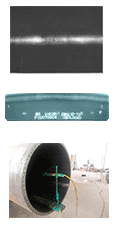
 Radiographic Testing Radiographic Testing |
|
|
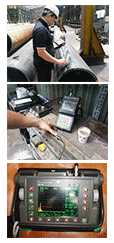
| Ultrasonic Testing |
|
|
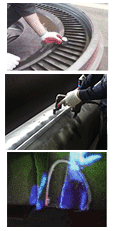
| Magnetic particle Testing |
|
|
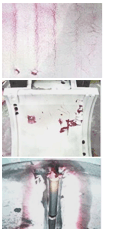
| Liquid Penetrant Testing |
|
|
| Eddy Current Testing |
|
|
| Leak Test |
|
|
 NonDestructive Testing